
Travel AI Agent Development Company: Why 2026 Is the Year of Agentic Travel
Businesses / Posted 2 days ago by alissa doe / 12 views / New
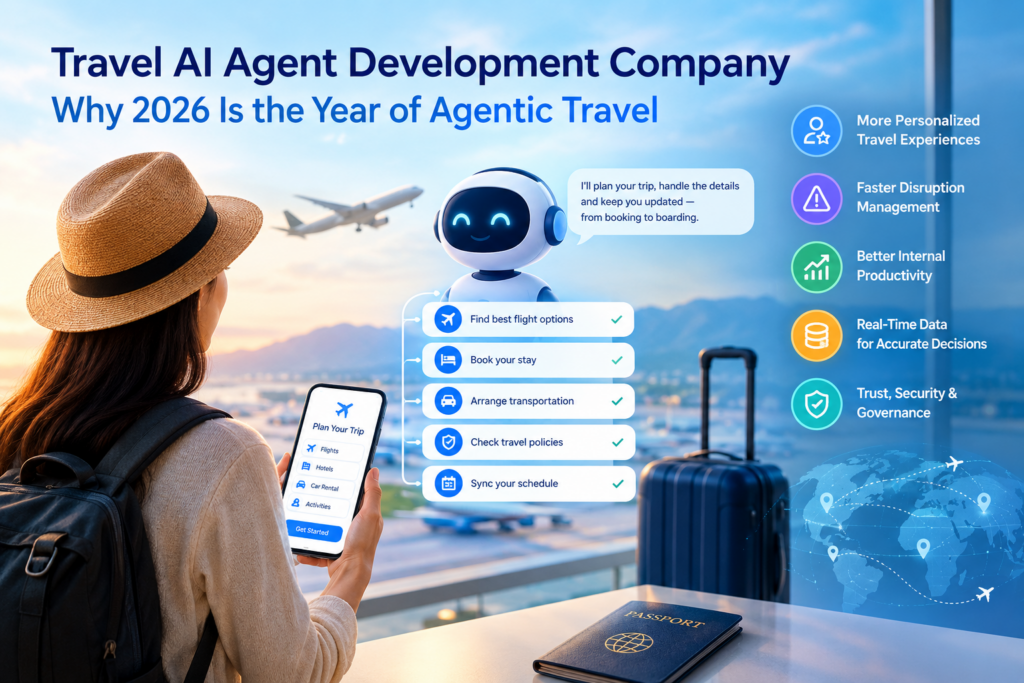
Travel technology is entering a decisive phase. The industry is moving beyond AI tools that simply answer questions or generate itineraries. In 2026, the real shift is toward agentic systems that can understand traveler goals, coordinate multiple steps, connect with operational systems, and support actions across the journey.
Recent industry research shows that 61% of surveyed travel businesses are already experimenting with or scaling agentic AI, while broader generative AI adoption is even higher. This marks a clear transition from experimentation toward infrastructure and execution.
From Conversational AI to Action-Oriented Systems
Traditional travel assistants respond to user prompts. They can recommend destinations, summarize hotel options, or build sample itineraries.
Agentic systems go further.
They can break a travel request into smaller tasks, evaluate constraints, access external systems, and coordinate actions. A traveler planning a business trip, for example, may need flight options, accommodation, ground transportation, policy checks, and schedule alignment handled together.
This is where a company can play a more strategic role. The challenge is no longer just building a conversational interface. It is creating the orchestration, integration, governance, and data layers required for AI to run reliably across real travel workflows.
Key Highlights Shaping Travel AI in 2026
Several trends are accelerating this shift:
- AI is becoming a starting point for travel discovery.
- Agentic workflows are moving closer to booking and service execution.
- Interoperability is becoming more important as agents connect to multiple external systems.
- Real-time inventory and operational data are essential for reliable recommendations.
- Governance and customer approval are becoming central to high-impact actions.
Research also shows that travel discovery, comparison, booking, and service may increasingly be mediated by intelligent agents rather than traditional browsing journeys.
Business Benefits
More Personalized Travel Experiences
Generative AI can process multiple traveler requirements simultaneously.
Instead of relying only on filters, an agent can interpret preferences around budget, destination type, travel dates, family needs, accessibility, accommodation style, and activities.
This creates more contextual recommendations and reduces the effort required by travelers.
Faster Disruption Management
Flight delays, cancellations, booking changes, and itinerary disruptions generate complex support requests.
Agentic systems can help find alternatives, retrieve policies, summarize options, and prepare next steps before a human agent becomes involved.
This can improve response speed while allowing service teams to focus on exceptional cases.
Better Internal Productivity
AI agents can also support employees by retrieving customer histories, comparing options, summarizing policies, or preparing responses.
The productivity opportunity comes from reducing repetitive information gathering work rather than simply replacing human interactions.
Real-Time Data Is the Critical Foundation
Travel is highly dynamic.
Availability changes. Prices fluctuate. Schedules move. Weather affects journeys. Policies and entry requirements can change.
An advanced language model cannot compensate for inaccurate operational data.
A strong travel ai agent development company therefore needs to prioritize integrations with trusted booking systems, inventory sources, customer platforms, operational applications, and authoritative data feeds.
The quality of the final experience depends as much on data access and system architecture as it does on the intelligence of the underlying model.
Trust and Governance Will Define Adoption
Agentic AI becomes more sensitive when it moves from recommendations to transactions.
Travel purchases can involve payments, personal information, identity documentation, cancellation conditions, and significant financial commitments.
A practical model is:
Recommendation → Review → Approval → Action
Organizations should also implement audit trails, permission controls, human escalation, secure data handling, and transparent explanations for important actions.
Where the Market Is Heading
The next stage of travel AI will not be defined by who builds the most conversational assistant.
It will be defined by who can connect AI with correct data, dependable workflows, secure transactions, and responsible for human oversight.
Travel companies should therefore think beyond isolated AI features and start building intelligent decision layers that can coordinate the complete customer journey.
In the agentic era, the competitive advantage will not come from AI that simply understands travel—it will come from AI that can act responsibly when the journey changes.
- Listing ID: 109257
- Country: USA
- City: Huston