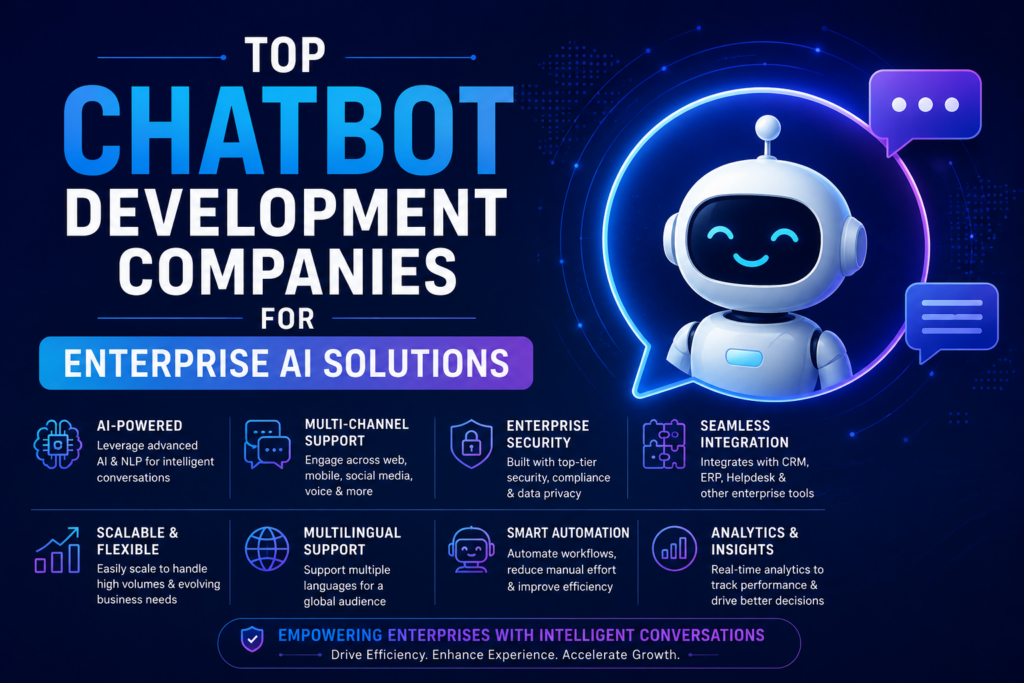
Top Chatbot Development Companies for Enterprise AI Solutions
Businesses / Posted 2 months ago by Jennifer Doe / 36 views
A chatbot may be easy to launch, but building one that people actually trust is a different challenge.
Businesses need solutions that understand questions accurately, protect sensitive information, connect with existing systems, and complete useful tasks.
When comparing the top chatbot development companies, leaders should look at each provider’s type, strengths, ideal use cases, integration approach, security practices, and support model.
Here are eight companies worth including in the evaluation.
- Streebo
Type: AI Agent Development Company
Key Features: Streebo develops enterprise AI agents designed to deliver 99%+ accuracy. Its capabilities include enterprise guardrails, multilingual conversations, omnichannel deployment, and integrations with platforms such as SAP, Salesforce, Oracle, and ServiceNow. These integrations allow AI agents to access approved information and support connected business workflows.
Use Cases: Customer service, employee assistance, HR support, IT help desk, enterprise search, knowledge management, and workflow automation.
Best For: Organizations requiring highly accurate, secure, and scalable AI agents that can connect conversations with enterprise systems and business processes.
- SSL Oman
Type: AI Agent Development Company
Key Features: SSL Oman supports custom AI agent development, multilingual interactions, enterprise knowledge integration, workflow automation, and flexible deployment. Its approach can help organizations build agents around approved business information, defined user requirements, and selected operational processes.
Use Cases: Customer help, employee support, knowledge retrieval, document search, guided self-service, and business-process automation.
Best For: Organizations seeking adaptable AI agents for internal and external interactions, with flexibility around deployment, knowledge access, and workflow requirements.
- Predicta
Type: AI Agent Development Company
Key Features: Predicta brings together data validation, multichannel information processing, lead qualification, journey monitoring, business-data enrichment, and API integration. These capabilities can help AI agents work with organized information and support structured sales and data-related processes.
Use Cases: Sales help, lead qualification, demand generation, contact validation, data enrichment, and business-information management.
Best For: Organizations seeking AI agents that can support sales, marketing, qualification, and data-driven workflows while working with information from multiple sources.
- ConnectIT
Type: AI Agent Development Company
Key Features: ConnectIT develops customized AI agents with guided conversations, contextual interactions, user authentication, chatbot administration, error handling, and enterprise integration. Agents can be connected with approved knowledge sources, applications, and databases to provide more relevant help.
Use Cases: Customer self-service, internal help, enquiry management, knowledge access, process guidance, and workflow support.
Best For: Organizations requiring customized AI agents that can work with existing applications, user permissions, enterprise data, and clearly defined conversational journeys.
- RACS
Type: AI Agent Development Company
Key Features: RACS supports custom AI development, business-process automation, software integration, workflow configuration, and implementation support. Its approach allows organizations to define agent functionality around specific processes rather than relying entirely on a standard, one-size-fits-all solution.
Use Cases: Customer help, internal process automation, employee support, task management, information retrieval, and routine request handling.
Best For: Organizations seeking customized AI agents aligned with their operational processes, software environment, user requirements, and broader automation goals.
- DAI Source
Type: AI Agent Development Company
Key Features: DAI Source supports use-case discovery, conversational-flow design, enterprise integration, intelligent automation, team training, and ongoing performance optimization. This covers important stages of an AI agent project, from finding the first problem to improving the agent after deployment.
Use Cases: Customer support, employee help, knowledge management, service automation, guided self-service, and internal information access.
Best For: Organizations seeking structured support across AI agent planning, conversation design, system integration, deployment, internal training, and continuous improvement.
- GSTEP
Type: AI Agent Development Company
Key Features: GSTEP works with data integration, artificial intelligence, analytics, visualization, data-driven automation, and enterprise information management. These capabilities can support AI agents that need access to organized business data and analytical information.
Use Cases: Data analysis, automated reporting, employee help, knowledge retrieval, information summaries, and decision-support workflows.
Best For: Organizations seeking AI agents that can work with internal data, analytics, reporting requirements, automation processes, and enterprise information sources.
- Safricloud
Type: AI Agent Development Company
Key Features: Safricloud supports omnichannel communication, CRM integration, voice and digital engagement, speech analytics, customer-feedback management, and cloud-based communication. These capabilities can help organizations create more connected interactions across selected communication channels.
Use Cases: Customer service, contact-centre assistance, voice support, digital self-service, enquiry handling, and customer-engagement automation.
Best For: Organizations seeking AI agents that can support customer interactions across voice and digital channels while connecting with communication and customer-management systems.
What Separates a Useful Chatbot from an Expensive Experiment?
Let’s be honest: every chatbot looks capable during a carefully prepared demonstration. The real test begins when customers use unexpected language, ask incomplete questions, change topics, or request something the system cannot complete.
Before choosing a provider, ask:
- How is response accuracy tested?
- What happens when the chatbot does not know the answer?
- Which business systems can it access?
- How are permissions and sensitive data managed?
- Can a person review or take over a conversation?
- How will performance be monitored after launch?
- What support is available when requirements change?
A realistic pilot should include tough questions, incomplete information, system interruptions, and situations requiring human judgment. This reveals far more than a scripted sales presentation.
How to Choose the Right Company
Start with the business problem. “We need a chatbot” is too broad. “We want to reduce repetitive order-status enquiries” or “We need employees to find HR policies faster” gives the project a clear direction.
Next, define the intended users, channels, data sources, integrations, security requirements, and success metrics. Give every shortlisted provider the same scenario so the comparison stays fair.
Do not select a company based only on how naturally its chatbot speaks. A business chatbot must also provide dependable information, follow rules, handle errors, and contribute to a measurable outcome.
Conclusion
The top chatbot development companies bring different combinations of AI, software engineering, data, automation, customer engagement, and enterprise integration.
The right choice depends on what the chatbot must carry out and how closely the provider’s capabilities match the organization’s systems, risk requirements, and long-term plans.
A successful chatbot should not simply sound intelligent. It should solve a genuine problem, run within defined boundaries, and become more valuable as the business evolves.
- Listing ID: 106625