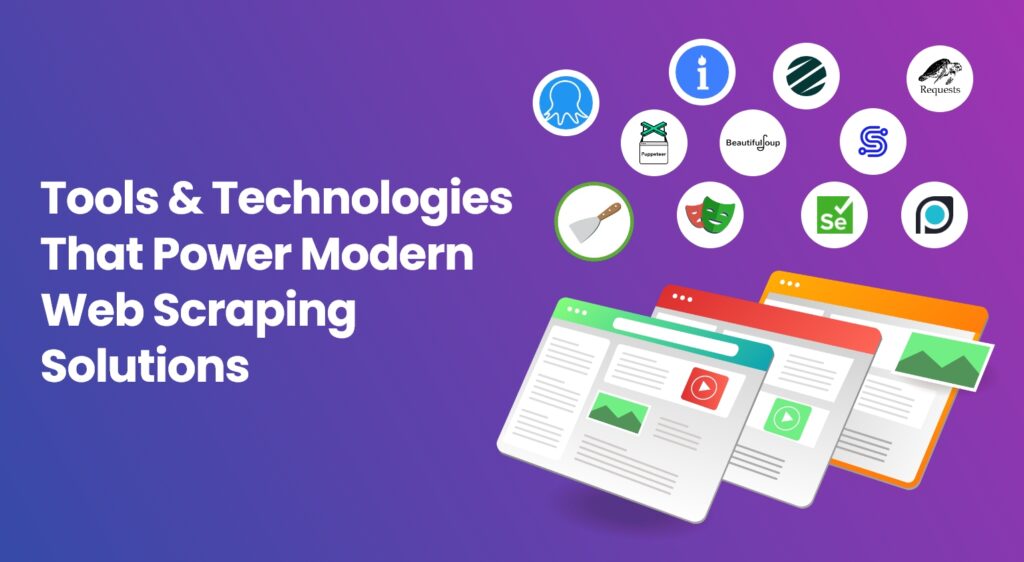
Tools & Technologies That Power Modern Web Scraping Solutions
Businesses / Posted 1 month ago by Rahul Dogra / 22 views
In the data-driven world, access to the right information for a given subject niche is crucial. As data is the new resource for business success, it is evident to analyze, process, and extract accurate information. Moreover, in the digitalized era, data is available in every format, from images to audio, and comes from various sources. Therefore, it is essential to have a handle on the right data aligned with business goals and interests. Usually, companies have vast databases where information can be accessed, the internet is another large pool of information, and social media platforms. To collect significant data, a web scraping or database scraping service plays a comprehensive role.
With the integration of technologies such as AI, web scraping has become easier in terms of legal processes and data extraction. This process of extracting information fuels business decisions and strategies, enabling them to maintain a competitive position in the dynamic market. By leveraging web scraping technologies, modern businesses can easily access information without spending much time or effort. Let’s understand what web scraping is and the modern tools used for it.
Understanding Web Scraping in Detail & Tools
Web scraping services, the process of extracting structured data from websites, is an essential skill in the modern data-driven world. The days of simple HTML parsing are essentially over, thanks to growing tech.
Today’s dynamic, JavaScript-heavy sites and sophisticated anti-bot measures demand a more powerful and accurate toolkit. Usually, firms get confused between web scraping and data mining, as both concepts are similar but have subtle differences.
Choosing the right tool for web scraping depends entirely on your project’s scope: are you doing a quick, one-off task, a large-scale enterprise crawl, or dealing with a site that requires complex user interaction? Here are the top 7 tools that form the backbone of modern, efficient, and robust web scraping solutions.
1. Scrapy (Python Framework):
Scrapy is the undisputed champion for large-scale, asynchronous web crawling and scraping. It’s not just a library; it’s a full-fledged, battle-tested Python framework.
- Core Strength: One of the most renowned tools built for scalability and speed. It handles concurrent requests asynchronously, meaning your scraper can process multiple URLs at once.
- Key Features:
-
- Built-in Components: Comes with modules for handling requests, following links, session management (cookies), and throttling.
- Middleware System: Highly extensible via middleware for tasks like user-agent rotation, proxy integration, and handling retries.
- Export Formats: Easily export scraped data to JSON, CSV, and XML.
- Best For: medium or enterprise-level projects requiring massive data extraction. Developers are comfortable with Python and framework.
- Limitation: It is primarily designed for static content. Scraping JavaScript-rendered sites requires integration with a headless browser (like Playwright or Splash), which adds complexity.
2. Playwright & Puppeteer (Headless Browser Automation):
In this modern web scraping tool, much of a page’s content is rendered by JavaScript. Traditional tools fail here. Headless browsers simulate a real user opening a browser, executing JavaScript, and fully rendering the page.
- Core Strength: Handling dynamic content(JavaScript, AJAX, Single Page Applications) and simulating complex user interactions (clicks, scrolls, form submissions).
- Language Support: Available for Python, Node.js, Java, and C.
- Modern Features: Includes powerful “auto-wait” capabilities that automatically wait for elements to be ready, making scrapers more reliable.
- Primary Focus: Node.js library for controlling Chrome/Chromium over the DevTools Protocol.
- Speed: Breakneck for JavaScript environments.
- Best For: Websites with heavy reliance on JavaScript, AJAX calls, or login-protected.
3. Beautiful Soup (Python Parser):
Beautiful Soup is a library. It is an indispensable tool for parsing HTML and XML documents, often paired with an HTTP client like Python’s `requests`.
- Core Strength: Simplicity and parsing flexibility. It turns messy, broken HTML into a navigable parse tree, allowing you to search for and extract data using familiar methods easily.
- Key Features:
-
- Forgiving Parser: Can handle badly formed markup.
- Intuitive API: Very easy to learn and use, perfect for beginners.
- Best For:
-
- Small, focused scraping tasks on static HTML pages.
- Quick prototyping or one-off data pulls.
- Parsing the HTML output from headless browsers.
- Limitation: It does not handle making the HTTP request itself (needs `requests`) and cannot execute JavaScript.
4. Selenium WebDriver (Browser Automation):
Selenium, the veteran of browser automation, is used primarily for automated testing but remains a powerful tool for web scraping that requires user-like interactions.
- Core Strength: Multi-language and Multi-browser compatibility. It provides a standardized API (WebDriver) to control nearly any browser (Chrome, Firefox, etc.) in any popular language.
- Key Features:
- Whole Browser Interaction: Can click buttons, fill forms, navigate, and handle dynamic content just like a human user.
- Vast Ecosystem: Huge community support and extensive documentation.
- Best For:
- Scraping sites with complex user journeys (e.g., login, multi-step forms).
- Scraping data that requires running JavaScript.
- Limitation: It is slower and more resource-intensive than Scrapy or dedicated headless browser tools like Playwright, as it launches a whole browser instance.
5. ScraperAPI / ZenRows / Bright Data (All-in-One APIs):
These are managed, cloud-based, or API-first solutions that handle the most frustrating aspects of modern scraping for you.
- Core Strength: Bypassing anti-bot measures at scale without managing infrastructure. They manage proxies, CAPTCHA solving, and JavaScript rendering.
- Key Features
- Automatic Proxy Rotation:Uses a massive pool of residential and datacenter proxies to avoid IP bans and geo-blocking.
- CAPTCHA & Anti-Bot Bypassing: Built-in logic to handle standard anti-bot services (Cloudflare, Akamai, etc.).
- JavaScript Rendering: Easily handles dynamic sites with a simple API parameter.
- Best For:
- Large-scale, high-reliability commercial scraping projects.
- Teams that want to focus on data parsing rather than infrastructure and maintenance.
- Limitation: Costs can scale up rapidly with volume, and you have less direct control over the infrastructure.
6. Octoparse / ParseHub (No-Code/Visual Tools):
For users or teams without strong programming expertise, visual scraping tools provide an excellent solution.
- Core Strength: User-friendly, point-and-click interface. No coding is required for basic to intermediate scraping tasks.
- Key Features:
- Visual Workflow Builder: The user can click on the data as desired, and the tool builds the scraping rules.
- Cloud Execution: Runs scrapers on a dedicated cloud platform, freeing up your local computer.
- Task Scheduling: Allows for scheduled, recurring scraping jobs.
- Best For: Business analysts, marketers, or non-developers needing quick data. Prototyping and rapid data gathering.
- Limitation: Can struggle with highly complex, dynamic websites or non-standard scraping requirements that are easy to address with custom code.
7. Requests (Python Library):
While technically just an HTTP client, the Python `requests` library is the fundamental first step for any Python scraping project involving static content.
- Core Strength: Simplicity and speed for static content. It allows you to make an HTTP request to a URL and retrieve the raw HTML content with minimal code.
- Key Features:
- Easy HTTP Calls: Simple functions for GET, POST, and other methods.
- Header Customization: Easily spoof user agents and add custom headers for basic anti-bot evasion.
- Session Management: Supports session objects for persistence (e.g., login).
- Best For:
- The first step in a Beautiful Soup pipeline.
- Scraping static websites (where all data is in the initial HTML).
- Limitation: Cannot execute JavaScript or handle dynamic content.
Concluding Remarks
Web scraping or database scraping services provide valuable information that helps firms make strategic decisions and thrive in a dynamic market.
- Listing ID: 69541
- Country: USA
- City: Austin