
The Evolution of Editing: Paraphrase, Summarizer, and Punctuation Innovations
Businesses / Posted 3 months ago by rephrase world / 70 views
The Evolution of Editing: Paraphrase, Summarizer, and Punctuation Innovations
Writing has always been a fundamental part of human communication. From handwritten manuscripts to digital documents, the way people create and refine content has changed dramatically over the years. One of the most significant developments in modern writing is the evolution of editing technologies. Today, tools powered by artificial intelligence assist writers in improving sentence structure, refining ideas, and ensuring grammatical accuracy. Among these advancements, punctuation innovations have played a critical role in making communication clearer and more effective.
Alongside punctuation technologies, paraphrasing and summarizing tools have transformed the editing process by helping writers improve readability, eliminate repetition, and condense complex information. These innovations are not intended to replace human creativity but to support writers in producing polished, engaging, and accurate content.
This article explores how editing has evolved through paraphrase, summarizer, and punctuation innovations, and why these technologies have become essential in modern communication.
Understanding the Importance of Editing
Editing is much more than correcting spelling mistakes. It involves improving clarity, refining ideas, enhancing readability, and ensuring consistency throughout a piece of writing.
Without effective editing, even valuable information can become difficult to understand. Readers may lose interest if content contains awkward phrasing, repetitive language, or incorrect punctuation. The editing process ensures that messages are delivered accurately and professionally.
Historically, editing was entirely manual. Writers relied on personal proofreading skills or professional editors to review their work. While effective, this process was often time-consuming and prone to human oversight.
Technological advancements have significantly changed this landscape, making high-quality editing accessible to a broader audience.
The Historical Role of Punctuation in Communication
To understand the evolution of punctuation technology, it is helpful to examine its origins.
In ancient times, written texts often lacked spaces and punctuation marks. Readers had to interpret sentence boundaries and meaning based solely on context. This made reading challenging and increased the likelihood of misunderstanding.
Over time, punctuation marks were introduced to guide readers through written language. Commas, periods, question marks, and other symbols became essential tools for clarifying meaning.
For example:
- Let’s eat, Grandma.
- Let’s eat Grandma.
The placement of a comma changes the meaning entirely.
This simple example illustrates why punctuation has always been crucial for effective communication.
Why Punctuation Matters in Modern Writing
In today’s digital environment, readers expect content to be clear and easy to follow. Proper punctuation supports this expectation by improving readability and preventing confusion.
Enhancing Clarity
Punctuation helps organize ideas and establish relationships between sentences and clauses. Readers can process information more efficiently when punctuation is used correctly.
Supporting Professionalism
Business communications, academic papers, and published content require accuracy and attention to detail. Incorrect punctuation can undermine credibility and create a negative impression.
Improving Reader Engagement
Well-punctuated content flows naturally, encouraging readers to remain engaged. Poor punctuation, on the other hand, disrupts comprehension and increases cognitive effort.
Preventing Misinterpretation
Small punctuation errors can significantly alter intended meanings. Accurate punctuation minimizes ambiguity and ensures that messages are understood correctly.
The Rise of Digital Editing Technologies
The digital revolution introduced word processors equipped with basic spelling and grammar checks. These early tools represented an important step forward in editing efficiency.
However, their capabilities were limited. They could identify obvious errors but often failed to understand context or stylistic preferences.
As artificial intelligence advanced, editing technologies became more sophisticated. Modern platforms now analyze sentence structure, readability, tone, and punctuation with remarkable precision.
These innovations have empowered writers across various industries to improve their communication skills.
Punctuation Innovations in Modern Editing Tools
Among the many advancements in writing assistance technology, punctuation innovations stand out for their impact on clarity and professionalism.
Context-Aware Corrections
Traditional grammar checkers focused on rule-based corrections. Contemporary punctuation tools use contextual analysis to determine whether punctuation choices align with the intended meaning.
For example, these systems can identify misplaced commas, missing apostrophes, and improper quotation mark usage while considering sentence context.
Real-Time Suggestions
Modern punctuation tools provide immediate feedback as users type. This feature enables writers to correct errors during the drafting process rather than waiting until the final editing stage.
Real-time assistance improves efficiency and supports continuous learning.
Style Adaptation
Different writing situations require different punctuation approaches.
Academic writing often emphasizes formal structure, while marketing content may adopt a more conversational style. Advanced tools increasingly adapt recommendations based on the context and purpose of the document.
Educational Explanations
Many punctuation technologies now explain why specific corrections are recommended. This educational component helps users strengthen their understanding of punctuation rules over time.
The Evolution of Paraphrasing Technologies
Paraphrasing has long been an important editing technique used to improve clarity and eliminate repetitive language.
Traditionally, writers manually revised sentences to express ideas differently while preserving original meanings. This process required creativity and strong language skills.
Modern paraphrasing tools streamline this task by offering alternative wording and sentence structures.
How Paraphrase Tools Support Editing
Reducing Redundancy
Repeated phrases can make writing appear monotonous. Paraphrasing technologies introduce variety that enhances reader engagement.
Simplifying Complex Language
Technical or academic writing sometimes becomes difficult for broader audiences to understand. Paraphrase tools help simplify complicated expressions without sacrificing meaning.
Supporting Language Learners
Non-native English speakers often benefit from suggestions that improve fluency and sentence construction.
Encouraging Creativity
Alternative phrasing options inspire writers to explore different approaches to communication.
Although these technologies provide valuable assistance, human review remains essential to ensure accuracy and preserve authentic voice.
The Emergence of Summarizer Innovations
The increasing volume of available information has created demand for tools that simplify content consumption.
Summarizer technologies address this need by condensing lengthy materials into concise versions that emphasize essential points.
Benefits of Summarizer Tools
Saving Time
Students, professionals, and researchers often manage extensive reading lists. Summarizers help users identify important information quickly.
Improving Information Accessibility
Complex reports and research studies become easier to understand when key findings are presented clearly.
Enhancing Productivity
Writers can streamline content planning and research processes by extracting relevant insights efficiently.
Supporting Decision-Making
Business leaders frequently rely on summarized reports to evaluate opportunities and make informed decisions.
Summarizer innovations continue to evolve, offering increasingly accurate and context-sensitive outputs.
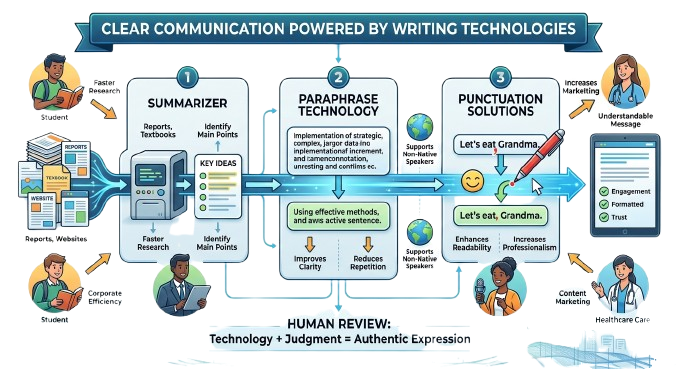
How Punctuation, Paraphrase, and Summarizer Technologies Work Together
While each editing technology serves a distinct purpose, their combined use creates a comprehensive writing workflow.
Stage One: Research and Information Gathering
Summarizer tools assist users in identifying critical insights from large volumes of information.
This foundation supports efficient content planning.
Stage Two: Draft Development
Writers create initial drafts focused on communicating ideas rather than achieving perfection immediately.
Creativity remains the priority during this phase.
Stage Three: Language Refinement
Paraphrasing technologies help improve readability by reducing repetition and strengthening sentence structure.
These adjustments contribute to more engaging communication.
Stage Four: Punctuation Review
Advanced punctuation tools identify errors related to:
- Comma placement
- Apostrophe usage
- Quotation marks
- Colons and semicolons
- Sentence boundaries
- Parenthetical punctuation
Correct punctuation enhances clarity and professionalism.
Stage Five: Human Evaluation
Despite technological advancements, human judgment remains indispensable.
Writers should carefully review all suggestions to ensure consistency with intended meaning and style.
The Impact of Editing Innovations Across Industries
Editing technologies benefit professionals across numerous sectors.
Education
Students use punctuation tools to improve essays and assignments. Summarizers assist with reviewing academic materials, while paraphrasing tools support writing development.
Content Marketing
Digital marketers produce high volumes of content. Editing technologies help maintain quality and consistency while improving productivity.
Business Communication
Professional emails, reports, and presentations require clear and polished language. Punctuation innovations enhance credibility and effectiveness.
Journalism
Reporters and editors rely on efficient editing processes to meet deadlines while maintaining accuracy.
Healthcare and Research
Medical professionals frequently review extensive documentation. Summarizer technologies facilitate quicker understanding of critical information.
Challenges and Limitations of Editing Technologies
Although editing innovations offer substantial advantages, they are not without limitations.
Contextual Complexity
Some writing situations involve nuances that automated systems may not fully understand.
Dependence on Technology
Excessive reliance on editing tools can hinder the development of independent writing skills.
Maintaining Authentic Voice
Automated suggestions occasionally alter tone or style in ways that do not align with the writer’s intentions.
Necessity of Human Oversight
Technology supports editing, but final decisions should always involve human evaluation.
Recognizing these limitations encourages responsible use of writing technologies.
The Future of Punctuation and Editing Innovations
The future of editing technology promises even greater sophistication.
Emerging developments may include:
- Personalized editing recommendations based on writing habits
- Enhanced contextual understanding
- Improved multilingual support
- Seamless integration with workplace platforms
- More advanced punctuation analysis for stylistic purposes
As artificial intelligence continues to evolve, editing tools will likely become increasingly intuitive and adaptable.
However, creativity, empathy, and critical thinking will remain uniquely human strengths that technology cannot replicate.
Best Practices for Using Editing Technologies
To maximize benefits, writers should consider the following guidelines:
Treat Technology as a Partner
Editing tools should complement rather than replace human expertise.
Review Suggestions Carefully
Not every recommendation will align with the intended message or style.
Continue Learning
Educational explanations provided by punctuation tools can strengthen long-term writing skills.
Preserve Individual Voice
Authenticity remains essential for meaningful communication.
Balancing technological support with personal judgment leads to stronger outcomes.
Conclusion
The evolution of editing has transformed the way people communicate through writing. Innovations in paraphrasing, summarizing, and especially punctuation technologies have made it easier to produce content that is clear, engaging, and professional.
Punctuation tools improve readability by clarifying meaning and reducing errors. Paraphrasing technologies enhance sentence variety and simplify complex ideas. Summarizer innovations help users process large amounts of information efficiently.
Together, these advancements support writers across education, business, marketing, journalism, and many other fields. While technology continues to evolve, human creativity and thoughtful editing remain at the heart of effective communication.
By embracing these innovations responsibly, writers can improve both the quality and impact of their work in an increasingly digital world.
- Listing ID: 93071
- Country: USA
- City: houston city