
Bamboo Flooring vs. Engineered Hardwood
Home Renovations / Posted 5 months ago by bamboo flooring / 119 views
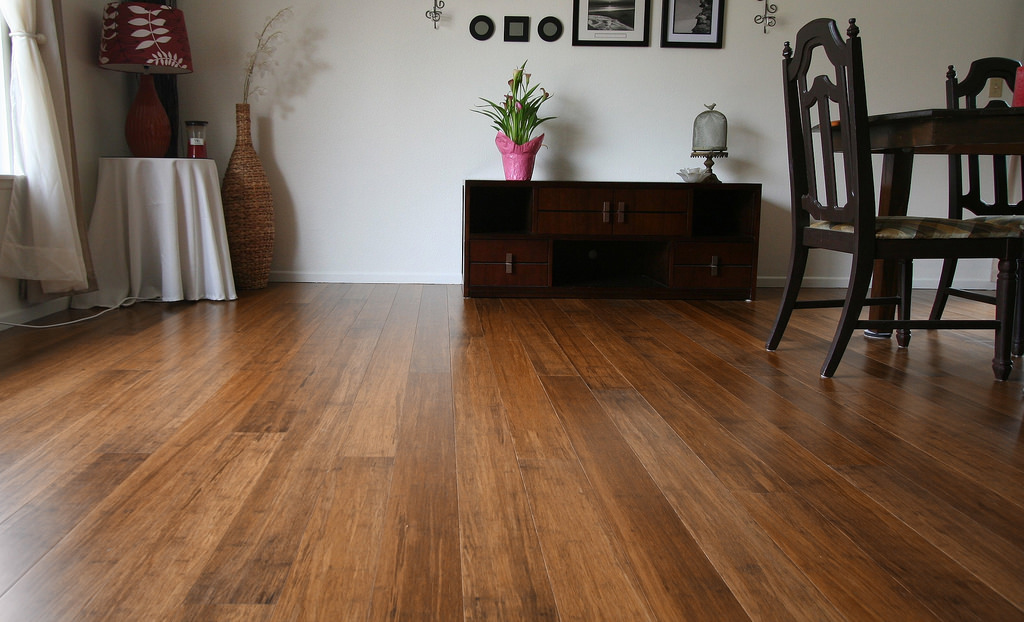
The decision-making process for residential flooring usually begins with a specific visual aesthetic, but it quickly shifts toward a more practical, almost defensive mindset. For those living in active households—places where muddy paws, dropped kitchen utensils, and the frantic sliding of chairs are daily occurrences—the primary question isn’t just about what looks best in a showroom. The real concern is which material will survive the next decade without succumbing to the relentless pressure of a busy life.
Engineered hardwood has long been the industry standard for those seeking the look of solid timber with added dimensional stability. However, bamboo has emerged as a formidable challenger, particularly in its strand-woven form. Both materials are engineered products, but their internal physics and raw components differ significantly. Determining which one lasts longer requires a deep dive into the mechanics of their construction and how they react to the “chaos variables” of a modern home.
The Structural Comparison: How They Are Built
To understand longevity, we must first look at the “skeleton” of these two materials. Neither is a simple, solid plank of wood harvested directly from a tree. They are both sophisticated composite products designed to overcome the natural limitations of organic fibers.
Engineered Hardwood
Engineered hardwood is built like a high-performance sandwich. It typically consists of a top layer of genuine timber—known as the wear layer—bonded to a core of high-quality plywood or high-density fiberboard (HDF). This core is usually composed of multiple layers of wood grain running in opposing directions. This cross-lamination is the “secret sauce” of the product; it creates a counter-force that prevents the plank from expanding or contracting excessively when the temperature or humidity shifts.
Bamboo Flooring
Bamboo flooring comes in two primary varieties that dictate its lifespan. Traditional bamboo is made by laminating strips of the grass together, either horizontally or vertically. While attractive, it behaves more like a soft hardwood. Strand-woven bamboo, however, is a different animal. It is created by shredding bamboo fibers, soaking them in high-strength resins, and compressing them under immense pressure into a solid block. This block is then milled into planks. The result is a material that is significantly denser and more “armored” than almost any traditional wood species.
The Janka Hardness Test: Measuring the Defense
When we talk about which floor “lasts longer,” we are often really talking about which floor resists denting and gouging. In the flooring industry, this is measured by the Janka Hardness Scale. This test measures the amount of force (in pounds-force) required to embed a $0.444 \text{ inch}$ ($11.28 \text{ mm}$) steel ball halfway into the material.
The Janka ratings for these two competitors reveal a stark contrast:
Engineered White Oak: Typically ranges from $1,200$ to $1,360$ lbf.
Engineered Hard Maple: Usually sits around $1,450$ lbf.
Strand-Woven Bamboo: Frequently tests between $2,800$ and $3,500$ lbf.
From a purely mechanical standpoint, strand-woven bamboo is twice as hard as most common engineered hardwoods. In a busy home where heavy toys are dropped or large dogs run through hallways, the bamboo floor is statistically much less likely to develop the permanent, crushed-fiber dents that eventually force a homeowner to replace a floor. If your definition of “lasting longer” is maintaining a smooth, unblemished surface under physical impact, strand-woven bamboo holds a clear advantage.
Dimensional Stability: The Battle Against Moisture
While hardness protects against dents, dimensional stability protects against structural failure. A floor that “lasts” is one that stays flat and connected.
Engineered hardwood was specifically designed to solve the “cupping” and “gapping” issues of solid wood. Because of its multi-ply core, it is remarkably stable. It is often the preferred choice for installation over concrete slabs or in regions with significant seasonal humidity swings.
Bamboo, being a grass, is naturally more resistant to water than many woods, but it is not immune. Traditional horizontal and vertical bamboo can be somewhat temperamental, expanding more than engineered wood in humid conditions. However, the high resin content in strand-woven bamboo acts as a moisture barrier at the cellular level. This gives it a density $\rho \approx 1.1 \text{ g/cm}^3$ or higher, which makes it much harder for water vapor to penetrate the fibers.
In a kitchen or an entryway where occasional spills or wet footprints are inevitable, both materials perform well if addressed quickly. However, the engineered hardwood’s plywood core is specifically designed to handle subfloor moisture wicking, making it a slightly safer bet for basements or below-grade installations.
The Wear Layer: The Key to Renewable Life
A critical factor in the longevity of any floor is its ability to be refinished. A floor that can be sanded down and recoated is a floor that can last for $50$ years. A floor that cannot be sanded is a “single-life” product.
Most engineered hardwoods feature a wear layer ranging from $2 \text{ mm}$ to $6 \text{ mm}$. A $4 \text{ mm}$ wear layer can typically be sanded and refinished two or three times. This allows the homeowner to “reset” the floor if it becomes heavily scratched or if they simply want to change the color.
Strand-woven bamboo is essentially solid throughout its thickness. While it is incredibly difficult to sand because of its extreme density (it tends to “chew” through sanding belts), it is possible to refinish it. However, because it is so hard to dent in the first place, many homeowners find they never actually need a full sanding. A simple “screen and recoat” of the polyurethane top layer every decade is usually enough to maintain the aesthetic.
The “winner” in this category depends on your long-term plan. If you want the ability to change the floor’s color to match shifting design trends, engineered hardwood is more flexible. If you want a floor that simply refuses to wear out, bamboo’s uniform density is superior.
Sustainability and the Replacement Cycle
For the eco-conscious buyer, the lifespan of a product is intrinsically linked to its environmental footprint. A floor that lasts $20$ years but takes $80$ years to grow is a net loss for the planet.
Bamboo is a rapidly renewable resource, reaching full structural maturity in just $5$ to $7$ years. This means that even if a bamboo floor eventually needs replacing, the environment has already produced several “generations” of replacement material in the same time it takes for a single oak tree to reach maturity.
Engineered hardwood is more sustainable than solid wood because it uses less of the “prized” timber for the surface and relies on faster-growing secondary woods for the core. However, it still relies on timber that takes decades to grow. If you are looking for a material that aligns with a long-term, low-impact lifestyle, bamboo’s quick harvest cycle makes it the more responsible choice for a home that might see several renovations over a half-century.
Acoustic Performance and Underfoot Comfort
The “feel” of a floor contributes to how long you are willing to live with it. In a busy home, noise is a major factor.
Engineered hardwood generally offers a warmer, more “traditional” sound. When installed with a high-quality underlayment, it has a pleasant, solid thud underfoot. Bamboo, particularly the ultra-dense strand-woven variety, can feel and sound quite “hard.” Without a proper acoustic barrier underneath, it can sometimes produce a sharper “click” when walked on with hard-soled shoes.
In a second-story bedroom or a hallway where you want to minimize the sound of children running, engineered hardwood paired with a rubber or cork underlayment is often the more “livable” choice over many years.
The Maintenance Reality
Both floors require similar daily care: frequent sweeping or dust-mopping to remove abrasive grit. However, the finish on the planks is the real hero. Most high-end versions of both bamboo and engineered hardwood use a multi-layer aluminum oxide finish cured under UV light.
The longevity of this finish is what prevents the need for major repairs. In a busy home, the “busy-ness” often involves spills. Bamboo’s natural resistance to staining gives it a slight edge in the kitchen. If a glass of red wine is dropped on a strand-woven bamboo floor, the density of the material prevents the liquid from “diving” into the grain as quickly as it might in a softer oak or hickory veneer.
Making the Final Choice for Your Space
If we define “lasting longer” as the ability to withstand physical abuse without showing signs of wear, strand-woven bamboo is the clear victor. Its industrial-grade hardness and uniform density make it nearly impervious to the standard stressors of a high-traffic home. It is the flooring equivalent of an off-road vehicle—built for the bumps and designed to keep moving.
However, if “lasting longer” means the ability to adapt to a home’s changing style over $40$ years through multiple refinishing cycles, engineered hardwood with a thick wear layer ($4 \text{ mm}$ or more) is a powerful contender. It offers a timeless, classic appeal and a structural stability that is proven across millions of installations worldwide.
For most modern families dealing with the reality of pets, kids, and a lack of time for meticulous maintenance, the sheer toughness of bamboo offers a peace of mind that is hard to quantify in dollars. It allows the home to be lived in fully, without the constant anxiety of a “no shoes” policy or the fear of a dropped set of keys. By choosing the material that matches the specific “chaos level” of your household, you ensure that the foundation of your home remains beautiful and functional for decades to come.
Both materials represent a significant upgrade over synthetic laminates or luxury vinyl, providing a real, organic connection to the natural world. Whether you choose the resilient grass of the East or the storied timber of the West, investing in a high-quality engineered product is a commitment to a home that is built to endure.
- Listing ID: 86623
- Country: USA
- City: Gardena