
7 Challenges in AI Data Collection for Healthcare
Businesses / Posted 2 days ago by vanessa jaminson / 5 views / New
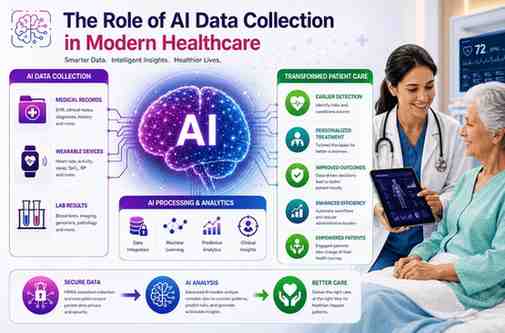
Artificial intelligence is transforming healthcare by helping providers improve diagnostics, predict patient outcomes, automate workflows, and support clinical decision-making. However, the effectiveness of any healthcare AI system depends heavily on the quality and diversity of the data used to train it. This makes AI Data Collection for Healthcare a critical yet challenging process.
Healthcare data comes from electronic health records (EHRs), medical images, clinical notes, wearable devices, laboratory reports, audio recordings, and other sources. Collecting and preparing this information requires careful attention to privacy, accuracy, compliance, and scalability.
In this article, we explore seven major challenges businesses and healthcare organizations face when collecting data for AI applications.
1. Protecting Patient Privacy and Sensitive Data
One of the biggest challenges in AI Data Collection for Healthcare is protecting patient information. Healthcare datasets can contain highly sensitive details, including names, medical histories, diagnoses, medications, and biometric information.
Organizations collecting data must implement strong security measures and follow applicable privacy regulations. In the United States, HIPAA is particularly important when handling protected health information.
Why Privacy Matters
A data breach can expose patients to serious risks while damaging an organization’s reputation. Therefore, healthcare AI projects need secure data collection, controlled access, anonymization, and de-identification processes before information is used for model training.
2. Ensuring High-Quality Healthcare Data
AI models are only as reliable as the data used to train them. Incomplete, outdated, duplicated, or incorrectly labeled healthcare data can negatively affect model performance.
For example, medical imaging datasets may contain inconsistent annotations, while clinical records can include missing fields or variations in terminology.
Improving Data Quality
Organizations can improve data quality through:
- Data validation and cleaning
- Standardized collection procedures
- Expert annotation
- Duplicate removal
- Consistent labeling guidelines
- Quality-control checks
Professional Healthcare AI Data Collection Services can help organizations establish structured processes for collecting and validating high-quality datasets.
3. Managing Data Diversity and Representation
Healthcare AI systems need datasets that represent different patient populations, medical conditions, environments, and demographics. A dataset that lacks diversity can produce biased or less reliable AI results.
The Challenge of Data Bias
For example, an AI model trained primarily on data from one demographic group may not perform equally well when applied to other populations. Similarly, medical imaging models require images collected using different devices, settings, and patient characteristics.
Building diverse datasets requires access to multiple reliable sources and carefully designed collection strategies.
4. Handling Data Labeling and Annotation
Raw healthcare data often needs detailed labeling before it can be used to train machine learning models. This can include identifying abnormalities in medical images, categorizing clinical text, transcribing medical conversations, or labeling specific patient outcomes.
Why Expert Annotation Is Important
Healthcare annotation can require specialized knowledge. Incorrect labels may teach an AI model the wrong patterns and reduce its accuracy.
Depending on the project, organizations may need trained medical professionals or experienced annotators working under expert-defined guidelines. Strong quality assurance processes are also necessary to identify and correct annotation errors.
5. Integrating Data From Multiple Sources
Healthcare information is rarely stored in a single standardized system. Data can come from hospitals, clinics, laboratories, EHR platforms, wearable devices, medical imaging systems, and patient applications.
Data Integration Challenges
Different sources may use different formats, terminology, structures, and standards. Combining this information into a consistent dataset can therefore be time-consuming.
Effective AI Data Collection for Healthcare requires data integration strategies that preserve accuracy while making information usable for AI development.
6. Scaling Healthcare Data Collection
AI projects often begin with relatively small datasets but require significantly more data as models become more sophisticated. Scaling collection while maintaining accuracy and compliance can be difficult.
Balancing Volume and Quality
Simply collecting more healthcare data does not guarantee better AI performance. Organizations must maintain consistent quality standards as datasets grow.
Scalable Healthcare AI Data Collection Services can support large-scale collection, annotation, validation, and quality control while helping organizations manage growing AI training requirements.
7. Meeting Regulatory and Ethical Requirements
Healthcare AI involves more than technical challenges. Organizations must also consider regulatory, ethical, and responsible-AI requirements.
Data collection processes should consider patient consent, privacy, security, fairness, transparency, and appropriate data usage. Organizations also need to understand the regulatory environment applicable to their specific healthcare AI application.
Building Responsible Healthcare AI
A responsible approach to data collection helps organizations develop AI systems that are more trustworthy and suitable for real-world healthcare environments. Documentation, governance, quality checks, and ongoing monitoring should be part of the data lifecycle.
How Healthcare Organizations Can Overcome These Challenges
Successful AI Data Collection for Healthcare requires a structured approach. Organizations should begin by defining their AI use case and identifying the types of data required. Next, they should establish privacy and security controls, create clear annotation guidelines, validate data quality, and continuously monitor the dataset.
Working with experienced data collection and annotation specialists can also make the process more efficient. A reliable partner can provide scalable collection workflows while supporting data quality, annotation accuracy, and project-specific requirements.
Conclusion
AI has enormous potential to improve healthcare, but high-quality training data is essential for turning that potential into reliable solutions. From protecting patient privacy to managing data diversity, annotation, integration, scalability, and compliance, organizations face several challenges throughout the data lifecycle.
By implementing structured processes and using reliable Healthcare AI Data Collection Services, businesses can build high-quality datasets that support more accurate, scalable, and responsible AI systems. As healthcare AI continues to evolve, investing in dependable data collection will remain an important foundation for successful AI development.
- Listing ID: 113433
- Country: USA
- City: texas